
Technical guide
Do you actually need a buffer?
System volume, buffers and volumisers — what to ask before you buy
Some heat pump systems genuinely need added water volume. Plenty have one fitted that should not. Here is how to tell the difference, and what to ask the installer who is quoting you.
- Topic
- System volume
- Covers
- Buffer vs volumiser
- For
- Homeowners & specifiers
- From
- Elixa Renewables
The principle
Why water volume decides how a heat pump behaves
It is total system volume that matters — radiators, underfloor circuits and pipework included. A buffer or volumiser is what you add when the emitters do not hold enough on their own. It is a top-up, not the whole answer.
A boiler can fire hard for ten minutes and stop. A heat pump cannot. It wants to run long, low and steady — and to do that it needs enough water in the system to run against.
It powers the defrost cycle. In cold, damp weather the outdoor unit ices up and briefly reverses, pulling heat back out of the heating system to melt it. That energy has to come from somewhere. In a system holding too little water, the defrost either drags the house noticeably cold or fails to complete — and a heat pump that cannot defrost properly cannot heat properly.
It stops short cycling. On a mild day the heat pump may only need a fraction of its output. With too little water to absorb that heat, it satisfies in minutes, shuts down, and starts again. BS EN 14511 advises a heat pump should not start more than three times an hour. Cycling wrecks both seasonal efficiency and compressor life, and it is the single most common cause of a heat pump costing more to run than the system it replaced.
How much is enough
- BS EN 14511
- Around 25 litres per kW of heat pump output, for defrost
- BS EN 15450
- Buffer volume in the range of 12 to 35 litres per kW
- Starts per hour
- No more than three, per BS EN 14511
- Useful volume
- Roughly 17–18 litres per kW of heat loss; more at very low flow temperatures
- What counts
- Radiators, underfloor circuits, active pipework, plus any buffer
- What does not
- Volume behind a closed zone valve or a shut TRV
Published guidance, for reference. Every system is sized against the specific appliance and the actual emitter volume on site.
The situations
Five properties that will need one
Four of these five are about flow and separation, not about litres. That distinction is what decides whether you need a volumiser, a buffer, or neither.
These are the situations where added volume or hydraulic separation stops being optional. If your property looks like one of them, ask any installer quoting you how they are handling it.
The heavily zoned house
Three or four zones, TRVs on most radiators, upstairs and downstairs on separate stats. On a mild evening almost everything closes and the water still available to the heat pump collapses to a fraction of the system total. The house that looks like it has plenty of volume on paper has almost none in practice.
The modern house with low water content emitters
Newer radiators hold far less water than the heavy steel panels they replaced, and underfloor heating in screed holds less than most people assume. A well insulated new build can easily fall short of the minimum volume its heat pump needs, precisely because everything in it is efficient and slim.
More than one thing to heat
Heating, hot water, an annexe, underfloor with a blending set, a swimming pool. Each wants a different flow rate and often a different temperature. Hydraulic separation lets each circuit run its own pump and its own conditions instead of fighting the others.
Two or more heat pumps in cascade
Multiple units feeding a common circuit need a stable point to meet. Without separation, one unit ends up pumping through the other, flow rates drift and the control strategy has nothing dependable to work against.
The retrofit where the pipework cannot change
Microbore, buried in solid floors, or a listed building where lifting the floors is not happening. If the distribution circuit physically cannot deliver the flow rate the heat pump needs, separation lets the heat pump run its own flow on its side and the house run what it can on the other.
The other half
When you should not fit one
An installer who cannot answer all three has not designed your system. Figures quoted from BS EN 14511 and BS EN 15450 as general guidance; sizing is always against the specific appliance and the actual emitter volume on site.
A buffer is not free. Fitted where it is not needed, or piped badly where it is, it costs efficiency, cupboard space and money. A single zone system, weather compensated, running open loop with emitters that already hold enough water does not need one. Adding a four-port buffer to that system introduces mixing between flow and return, raises the return temperature going back to the heat pump, and quietly takes efficiency off a system that was working properly. Some of the worst performing heat pump installations in the country have a buffer fitted for no reason other than habit.
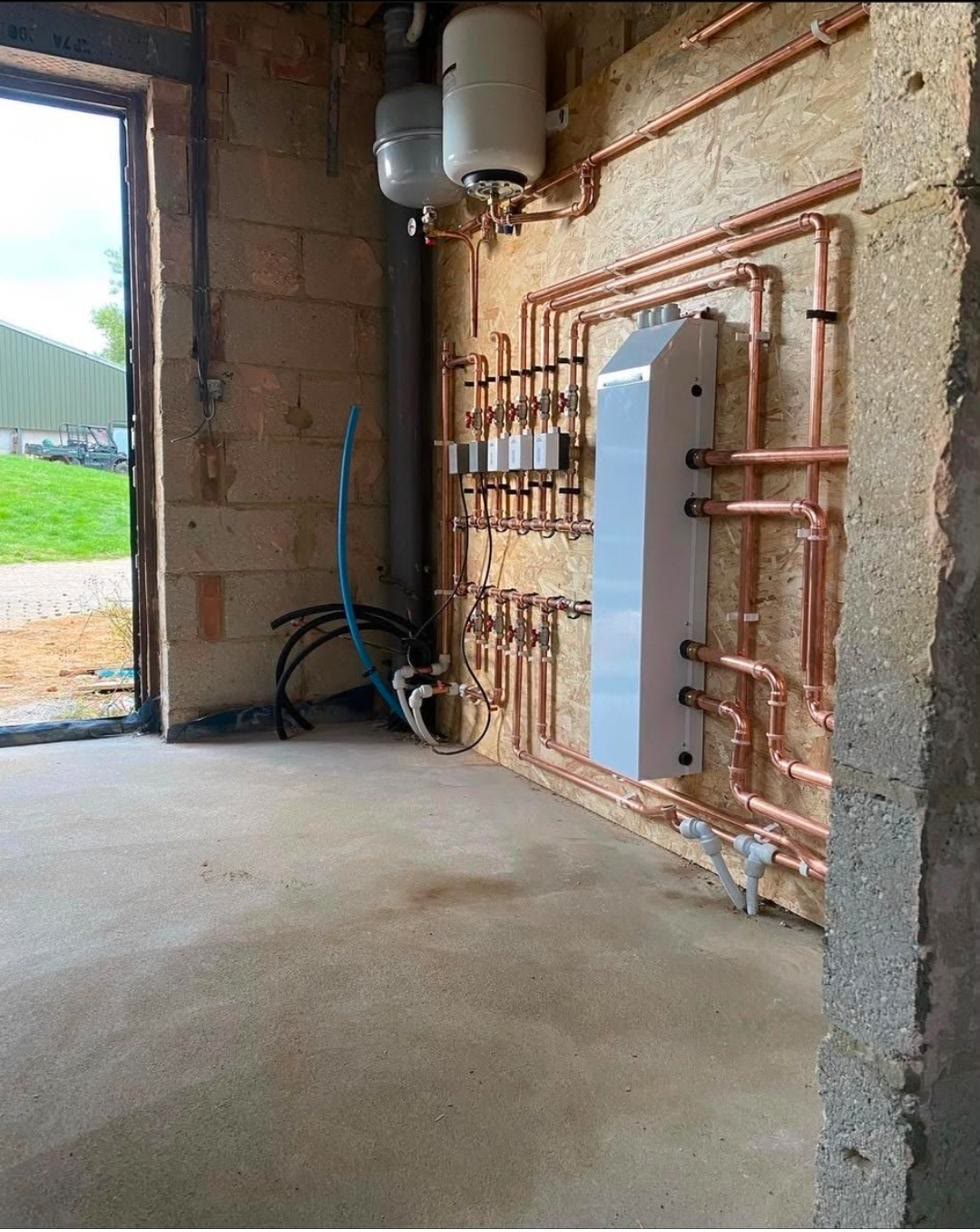
A volumiser is a two-port vessel plumbed in series, usually on the return to the heat pump. It adds volume and nothing else. No mixing, no penalty on return temperature. Where the only problem is litres, this is usually the right answer.
A four-port buffer hydraulically separates the heat pump circuit from the distribution circuits. That is what you want when flow rates or temperatures differ across circuits, or when multiple heat sources share one system — but it has to be piped and controlled correctly or it will cost you performance.
Question one
What is my total system volume, and what does the appliance require?
Question two
Am I getting a volumiser or a buffer, and why that one?
Question three
How is it piped, and what does it do to my return temperature?
The three questions above belong in every heat pump conversation — whoever you ask them of.
Not sure what you have been quoted for?
We will tell you plainly whether your property needs added volume, separation, both or neither — and show you the numbers behind the answer.